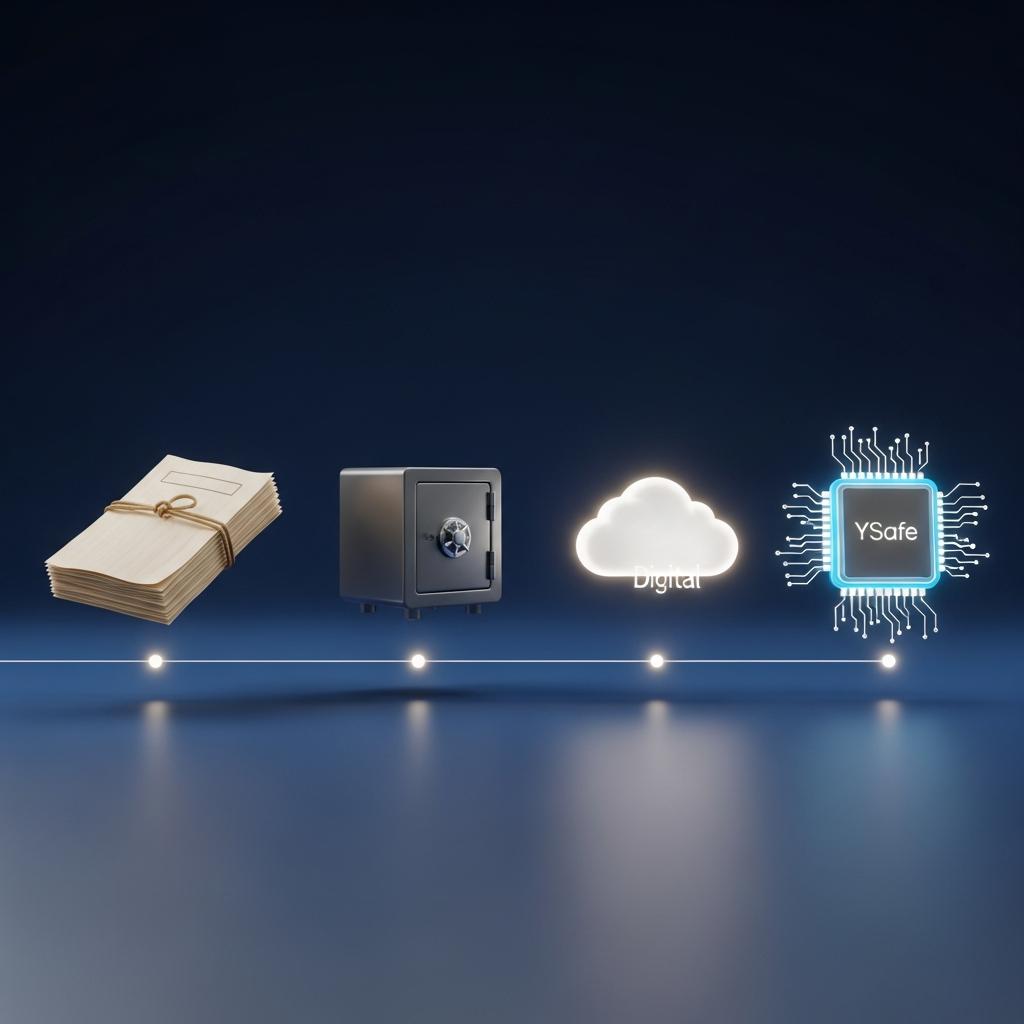
Induz extends Confidential Computing into Confidential Storage using Intel SGX, Control‑Path HSMs, and WORM‑based storage to keep data secure from memory to persistent storage, blocking rollback and insider attacks.
This report provides an exhaustive technical examination of the state of the art in Confidential Computing. As cloud infrastructure continues to scale, organizations face a critical vulnerability: while data is routinely encrypted at rest in storage systems and encrypted in transit across networks, it has historically remained exposed in plaintext while being actively processed within central processing units (CPUs) and random-access memory (RAM). This architectural gap leaves highly sensitive workloads, including artificial intelligence (AI) inference, cryptographic key management, and financial transaction processing, vulnerable to memory dump attacks, compromised hypervisors, and malicious cloud administrators.
Confidential Computing resolves this vulnerability through the deployment of hardware-based Trusted Execution Environments (TEEs), which isolate data and code execution in mathematically verifiable enclaves.4 Recent market analyses indicate that 75% of global organizations are currently adopting Confidential Computing, driven by stringent data sovereignty regulations such as the Digital Operational Resilience Act (DORA) and the demand for zero-trust cloud computing. This analysis critically compares the three dominant architectural paradigms. Intel Software Guard Extensions (SGX), Intel Trust Domain Extensions (TDX), and AMD Secure Encrypted Virtualization-Secure Nested Paging (SEV-SNP) and evaluates their respective attack surfaces. The evidence demonstrates that process-level isolation (Intel SGX) provides the most robust security posture for critical infrastructure. Furthermore, utilizing proprietary documentation for the Induz YSafe platform, this report details how the integration of Intel SGX, Control-Path Hardware Security Modules (HSMs), and rigorous remote attestation effectively mitigates advanced threats, fundamentally extending the boundaries of Confidential Computing into the novel domain of Confidential Storage.
The Evolution of Privacy-Enhancing Technologies and the FHE Problem
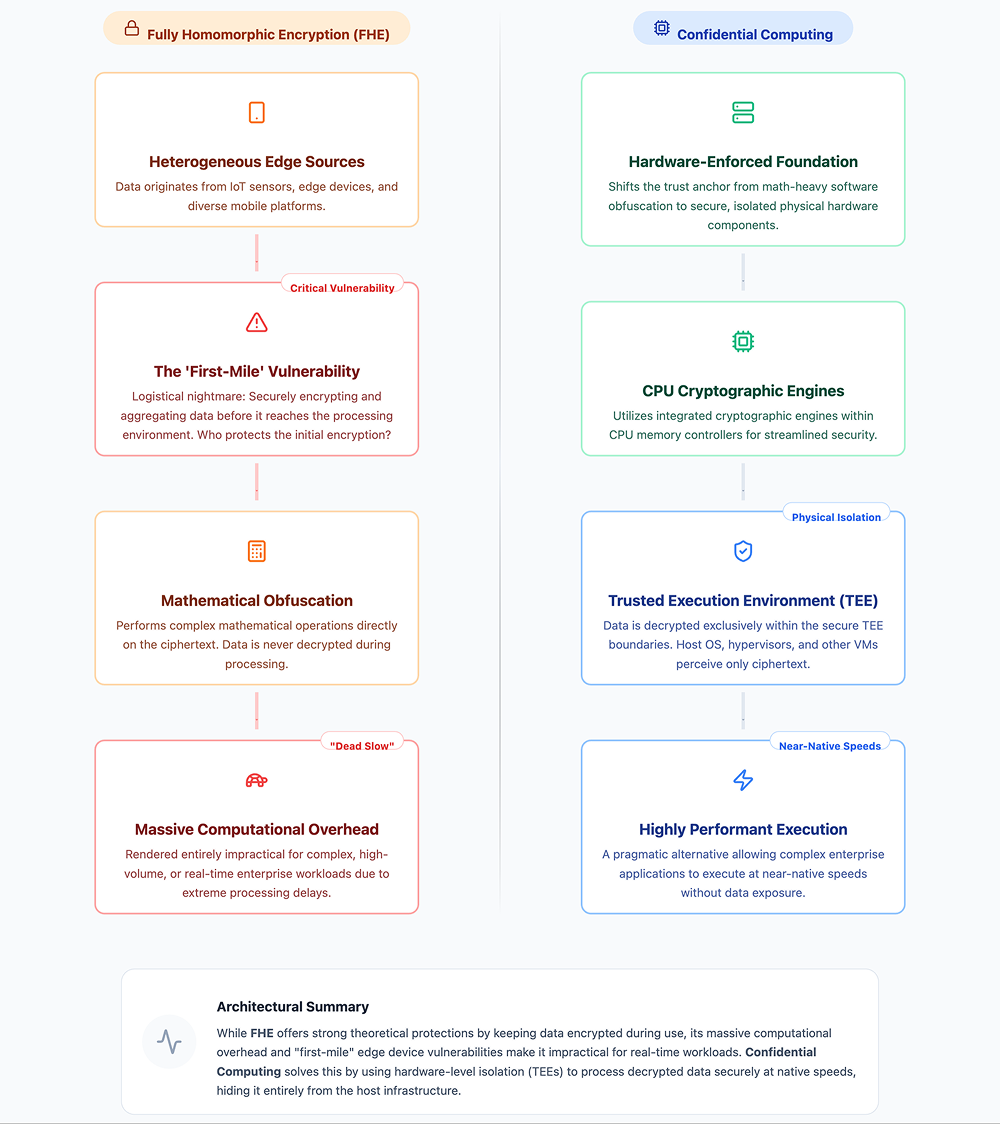
The transition toward securing data in use has driven the development of several Privacy-Enhancing Technologies (PETs), each offering distinct tradeoffs between computational efficiency and security guarantees. Among these, Fully Homomorphic Encryption (FHE) and Secure Multiparty Computation (SMPC) have garnered significant academic interest. Fully Homomorphic Encryption permits arbitrary mathematical operations to be performed directly on ciphertext, ensuring that data is never decrypted during processing.
However, there is a fundamental problem with FHE as a foundational security architecture. First and foremost, it is notoriously "dead slow" its massive computational overhead renders it entirely impractical for complex, high volume, or real-time enterprise workloads. Second, FHE introduces a critical “first mile” vulnerability: where is the data getting encrypted in the first place, and who takes responsibility for protecting that initial encryption environment? As data generation sources grow increasingly heterogeneous across edge devices, IoT sensors, and diverse mobile platforms, securely encrypting and aggregating this data before FHE processing becomes a logistical nightmare.
Confidential Computing presents a highly performant, pragmatic alternative by shifting the trust anchor from mathematical obfuscation to hardware-enforced physical isolation.Instead of processing ciphertext, Confidential Computing utilizes integrated cryptographic engines within the CPU memory controllers to decrypt data exclusively within the secure boundaries of the TEE. This approach allows applications to execute at near-native speeds while ensuring that the host operating system, the hypervisor, and other tenant virtual machines (VMs) perceive only encrypted ciphertext.
Confidential Computing
In-Depth Architectural Comparison: SGX, TDX, and SEV-SNP
The Confidential Computing ecosystem is currently characterized by a bifurcation in isolation strategies: process-level isolation, which secures specific application components, and VM-level isolation, which encapsulates entire operating systems.
Intel Software Guard Extensions (SGX): The Gold Standard
Intel SGX represents the genesis of modern commercial Confidential Computing, utilizing a highly targeted process-level isolation model. SGX introduces specific instruction set architecture (ISA) extensions that allow user-level applications to carve out secure memory partitions known as enclaves.
From a microarchitectural perspective, SGX safeguards these enclaves within the Enclave Page Cache (EPC). A specialized hardware component, the Memory Encryption Engine (MEE), sits between the CPU cores and the system memory, ensuring that any cache line evicted from the CPU is cryptographically secured before reaching the RAM.
The defining characteristic of Intel SGX and why it remains the superior choice for high-assurance environments is the extreme minimization of its Trusted Computing Base (TCB). The security model explicitly assumes that the entire host operating system, hypervisor, and system management modules are compromised.Trust is placed solely in the physical CPU package and the specific code executing within the enclave.
Achieving Line Rates with Custom Rust OS Libraries: Historically, utilizing SGX required developers to either manually partition applications or rely on heavy, third-party library operating systems (like Gramine or Scone), which introduced severe context switching overheads. At Induz, we bypassed this limitation entirely using advanced engineering techniques. The Induz YSafe platform achieves unprecedented line rates by executing on a proprietary, custom built OS library written entirely in Rust. By eliminating dependencies on third-party SGX OS libraries, Induz maximizes the native performance of the CPU while strictly maintaining SGX's microscopic TCB, achieving the perfect balance of ultimate security and blazing performance.
Intel Trust Domain Extensions (TDX)
To address the deployment complexity associated with legacy applications, Intel engineered Trust Domain Extensions (TDX), shifting the isolation boundary to the entire virtual machine. TDX permits a "lift-and-shift" deployment methodology, allowing full guest operating systems to execute securely within a Trust Domain (TD).
While TDX significantly reduces the barrier to entry, it expands the TCB to include the entire guest OS. Furthermore, because the trusted boundary encompasses the entire VM, input/output (I/O) intensive operations such as heavy network traffic or storage access require complex transitions between the encrypted guest and the untrusted host, sometimes resulting in overheads approaching 28.6%.
AMD SEV-SNP is a mature, VM-centric technology providing coarse-grained isolation for entire virtual machines. The architecture relies on an integrated hardware co-processor, the AMD Secure Processor (ASP), to generate and manage unique encryption keys for each guest VM.
SEV-SNP introduces the Reverse Map Table (RMP) to prevent a malicious hypervisor from executing data replay attacks or unauthorized page swapping. While highly regarded for minimal performance impact on standard CPU-bound cloud workloads, SEV-SNP suffers from the same fundamental architectural flaw as TDX: a massive Trusted Computing Base that includes millions of lines of potentially vulnerable OS kernel code.
TEE Architecture Decision Flow
Why VM-Level Isolation Fails
The fundamental flaw in VM-based Confidential Computing (TDX and SEV-SNP) is the implicit assumption that the guest operating system is secure. By including the guest OS within the TCB, these architectures inherit every unpatched zero-day vulnerability and privilege escalation exploit present in Linux or Windows kernels.15 An attacker who compromises the guest OS immediately gains unrestricted access to all "confidential" data, bypassing hardware protections entirely.
Furthermore, VM-based TEEs suffer from complex hardware-software boundaries that are frequently exploited. For AMD SEV-SNP, the recent "Heracles" attack demonstrated that malicious hypervisors could manipulate physical memory pages to construct chosen-plaintext oracles, successfully extracting authentication passwords and cryptographic keys.26 Similarly, Intel TDX has fallen victim to attacks like "TDXploit," which bypassed single-stepping mitigations to systematically leak cryptographic secret keys.
In stark contrast, Intel SGX operates under a deeply adversarial, zero-trust threat model, assuming the entire host operating system is actively malicious.12 Because SGX provides a highly granular, controlled environment, engineers can implement definitive mathematical countermeasures against side channels directly within their custom Rust libraries. For critical infrastructure, the ability to completely excise the operating system from the trust equation makes Intel SGX the only strategically sound architectural choice.
The Induz YSafe Architecture
Induz YSafe Architecture
The isolation provided by TEEs is meaningless if a data owner cannot verify that their workloads are running within genuine, uncompromised hardware. Remote Attestation provides this verification, acting as a digital certificate of authenticity that proves the integrity and identity of a remote execution environment before provisioning it with sensitive data.
Induz leverages this to engineer a mathematically verifiable Zero-Trust cloud architecture, integrating Intel SGX with decentralized key management via a unique Control-Path Hardware Security Module (HSM) model.
Delivering State and Remote Attestation via HSM
Traditional cloud platforms rely on centralized Key Management Systems (KMS), creating a catastrophic single point of failure. Induz eliminates this through "Keyless Security," where wrapper keys are generated and stored within a HSM residing physically within the customer's on-premises data center.
The bridge between the secure on-premises HSM and the untrusted public cloud is governed by automated Remote Attestation. When the customer's image launches inside an Intel SGX enclave in the cloud, the SGX hardware generates a cryptographically signed Quote. This evidence is transmitted directly to the customer's HSM. The HSM evaluates the hardware signature and mathematically compares the enclave's actual measurement against the expected baseline hash.
If validation is successful, the HSM establishes a secure TLS 1.3 channel terminating inside the SGX enclave and automatically releases the wrapper keys directly into the protected memory space. By binding key release to a hardware-verified execution state, Induz delivers robust remote attestation that guarantees sensitive data is only decrypted within an uncompromised environment, entirely mitigating rogue cloud administrators and hypervisor manipulation.
The Paradigm Shift: Runtime to Confidential Storage
While Confidential Computing excels at securing data in use, a critical architectural vulnerability remains at the boundary where volatile computation ends and persistent storage begins. Securing data only during runtime is fundamentally insufficient. The moment computation finishes and data persisted, it exits the secure enclave and becomes vulnerable to severe data-at-rest threats, most notably rollback attacks, resurrection attacks, and unauthorized historical pruning.
A rollback attack occurs when an adversary replaces the current encrypted persistent state of an application with an older, valid encrypted state. Because this older state was legitimately encrypted by the enclave in the past, the TEE accepts it, allowing attackers to revert financial transactions or revive deleted access policies, violating state continuity.
To comprehensively mitigate these threats, Induz engineered a radical extension of confidential computing into Confidential Storage.
WORM Storage, Auto-Versioning, and Inline Tokenization
The Induz YSafe architecture mandates Write-Once-Read-Many (WORM) storages as an immutable foundational primitive. By enforcing strict auto versioning, every single write operation is treated as an append-only transaction. This structural design inherently defeats rollback and resurrection attacks by maintaining an unalterable, cryptographically linked chain of state transitions that cannot be pruned or maliciously reverted by the host.
Furthermore, Induz implements a sophisticated Confidential Data Delivery Platform (CDDP) that performs inline tokenization seamlessly during both read and write operations. Rule-based delivery logic executing exclusively within the tamper-resistant SGX enclave replaces highly sensitive data attributes with randomly generated alphanumeric tokens before the data is written to disk. In the event of a catastrophic storage infrastructure breach, the exfiltrated data remains cryptographically meaningless.
Scalable Confidential Directory Service
Searching encrypted databases traditionally forces systems to download and decrypt entire datasets into the enclave, destroying performance. Induz resolves this through a patented Scalable Confidential Directory Service that utilizes fixed size Hash-based Message Authentication Codes (HMACs) alongside highly optimized binary encoding protocols.
Both attribute names and values are hashed using fixed size HMACs, ensuring absolute zero metadata exposure. Query execution operates through a highly efficient two-stage pipeline:
1. Untrusted Tier: The NoSQL database prefilters the dataset using extremely fast, constant-sized byte-level HMAC comparisons, drastically reducing the dataset size without decrypting a single byte.25
1. Trusted Tier (SGX Enclave): The reduced candidate set is loaded into our highly optimized Rust-based SGX enclave, where complex query semantics (wildcards, Boolean logic) are executed securely at line rates.
Conclusion
The aggressive transition from traditional perimeter-based security to Confidential Computing is an inevitable evolution. While VM based isolation paradigms like Intel TDX and AMD SEV-SNP offer operational convenience, their expansive Trusted Computing Bases and massive operating system dependencies introduce inherent structural vulnerabilities.
Intel SGX, defined by its strict process level isolation, remains the strategically superior architectural choice. The Induz YSafe platform maximizes this potential by leveraging custom-built Rust OS libraries to achieve line rate performance without third party bloat. By synthesizing secure SGX enclaves with on premises Control Path HSMs for rigorous remote attestation, Induz successfully decouples cryptographic sovereignty from untrusted infrastructure.
Most significantly, by recognizing that runtime protection is insufficient against persistent state rollback attacks, Induz has pushed the boundaries of the industry to forge the new domain of Confidential Storage. Through immutable WORM architectures, inline tokenization, and fixed size HMAC directory services, Induz ensures that highly sensitive information remains imperceptible and mathematically safeguarded from ingestion, through active computation, and into long-term persistent storage.
Claim your digital independence
Discover how Induz strengthens data security. Start your free trial today with zero commitment